Root Masses Mapped by Foot
The camera logs every intrusion with its distance and joint.

Naples grows exactly the trees that sewer lines fear most: ficus and banyan with root systems wider than their canopies, live oaks that forage for decades, all of them hunting moisture in sandy soil. A sewer lateral leaks a whisper of water vapor at every joint, and roots follow that whisper home. This page explains how roots get in, why clearing them is only half the job, and how the entry points get sealed so the cycle ends.
The camera logs every intrusion with its distance and joint.
Jetting strength is set for old iron, not guessed.
Lining closes the joints roots used, not just the roots.
Plans work around the canopy, not against it.
Roots do not break into sound pipe; they enter through joints and cracks that are already leaking vapor, then grow into masses that catch waste and back the house up. Cutting or jetting the roots out restores flow, but the entry stays open and the mass regrows, which is why root homes repeat on a cycle. The lasting fix pairs the clearing with a sealed interior, usually a CIPP liner, so roots find no opening. A camera run shows exactly where they are entering. Call (239) 448-0271 to schedule one.
A root tip is thinner than a hair and needs almost nothing to grow on: a film of moisture, a trace of nutrients, a crack to anchor in. Sewer joints supply all three. Clay and cast iron laterals were assembled in short sections, so a sixty-foot run can carry a dozen joints, and every joint that sweats vapor is broadcasting an invitation through the surrounding soil.
Once a tip is inside, the environment is perfect: constant water, constant nutrients, no drought, no winter. The root branches into a fine mass that fills the bore like a bottle brush, and the mass strains the flow until paper and grease mat against it. Understanding that sequence matters, because the mass is the symptom; the joint is the disease.
Even a well-made joint is not vapor-tight after decades of soil movement. The moisture escaping at each hub tells foraging roots exactly where the pipe runs, and the root follows the gradient straight to the opening. This is why root intrusion maps so neatly onto joint spacing on camera: a mass every three to six feet is the signature of joint entry, not random attack.
The signature Naples offenders. A mature ficus sends roots well beyond its drip line, and banyans add aerial roots that become new trunks and new root fronts. Their roots are aggressive, long-ranging, and strong enough to widen the joints they enter, prying sections apart as they thicken. Homes in Old Naples and Park Shore with heritage ficus canopies live with this pressure constantly.
A pipe cracked by settling or corrosion admits roots anywhere along the crack, not just at joints. On camera this looks different: one heavy intrusion at a damage point rather than the evenly spaced joint pattern. The distinction matters because a crack means the pipe wall itself is failing at that spot, and sealing strategy has to account for structure, not just openings.
Clay tile has a joint every few feet by design, and Orangeburg, the fiber pipe used in some postwar Florida building, softens and deforms with age until its seams gape. Both give roots a banquet of entries. Original lines of either material under Naples homes are best treated as systems to be lined or replaced, because clearing one mass leaves the other entries open for business.
You cannot see roots in a buried pipe from the surface, but you can read the pattern they create. These observations are what separate a root cycle from a one-time clog.
Root homes repeat. If drains slow or back up, get cleared, behave for six to eighteen months, and then repeat, that rhythm is regrowth from an unsealed entry. Write down the dates of the last few episodes. A regular cycle is close to proof, and it changes the conversation from clearing to sealing.
Sketch the run from house to street and mark every mature tree whose canopy or root zone crosses it. Ficus, banyan, and live oak near the path raise the odds sharply; palms, with their fibrous root balls, rarely intrude. The overlay tells the crew where the camera should expect company.
Before roots block a line, they narrow it, and narrowing announces itself as gurgling when big volumes drain, especially laundry discharge. A home with a root history plus new gurgling is a home whose mass has regrown. Catching that stage turns an emergency backup into a scheduled clearing and lining.
When drains run slowly, open the yard cleanout and look, without reaching in. Roots visible at the cleanout, or standing water that should not be there, confirm the line is involved rather than a single fixture. Then close it back up; the cutting tools for root masses are not homeowner tools, and a blade in old pipe does damage you will regret.
One boundary: avoid chemical root killers as a substitute for diagnosis. Poured into a line whose condition is unknown, they can damage already-failing pipe, kill the wrong section of a tree you value, and mask the pattern for a season while the joint widens. The camera takes one visit and answers everything the chemicals only postpone.
Roots work slowly until the day the mass mats shut completely, and that day usually arrives with a houseful of guests or a laundry marathon. If sewage is rising in a tub or floor drain, treat it as the emergency it is: stop water use, keep the family clear of the water, and call (239) 448-0271. The crew restores flow first, then shows you on camera exactly which joints the roots are using, so the permanent fix can be planned with the pressure off.
Everything starts with a sewer camera inspection, because root work without footage is gardening in the dark. The camera logs each intrusion by distance, grades its density, and judges the pipe around it: joints merely open, or walls cracked and deforming. That grading decides the plan, and it is the difference between a line that can be sealed and a line that needs to be replaced in the root zone.
Clearing comes first: hydro jetting with a root-cutting head strips the mass and scours the bore back to full width, with pressures matched to what old iron and clay can tolerate. Then the entries get closed. CIPP pipe lining builds a jointless pipe inside the old one, and roots outside it find no opening and no vapor trail to follow. Where roots have deformed or split the pipe itself, that section is planned for bursting replacement. The tree, in almost every case, stays exactly where it is.
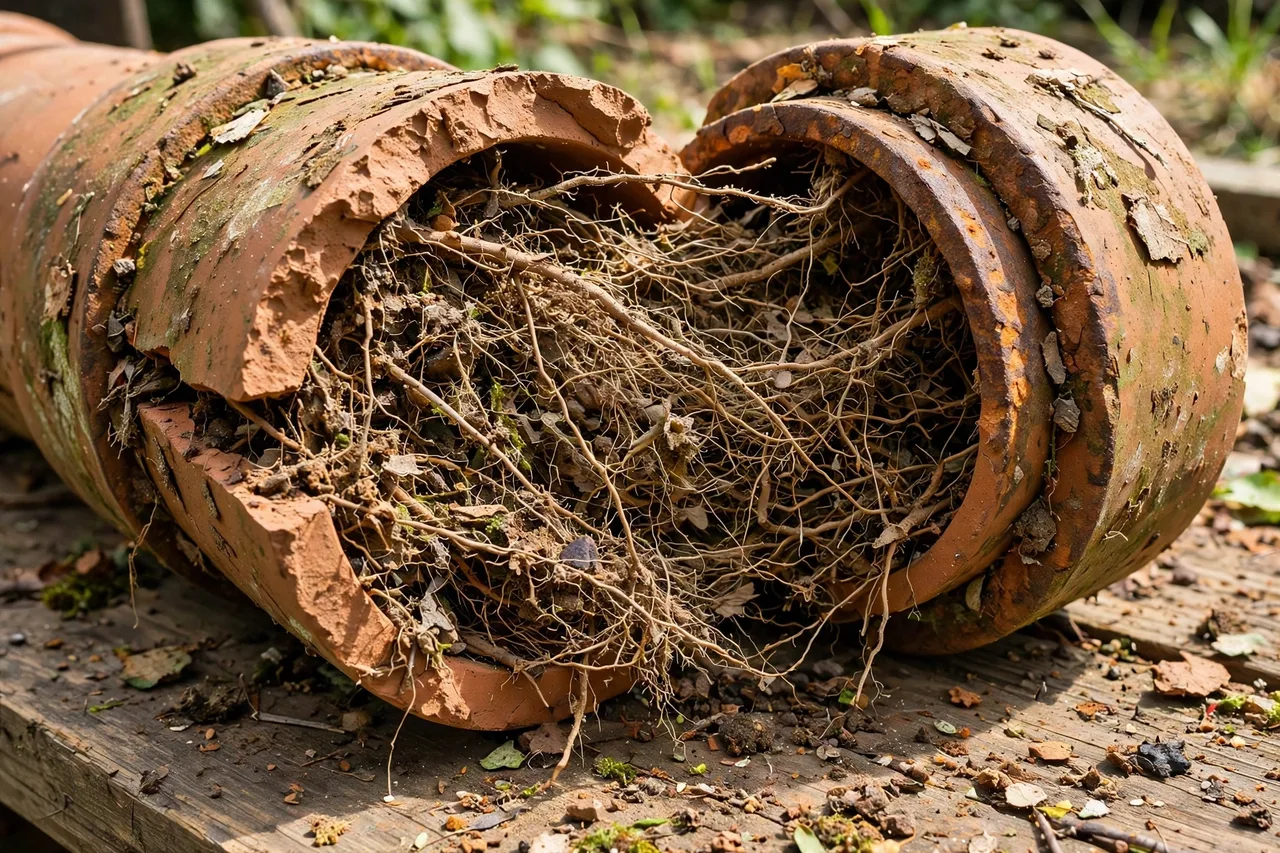
Ficus and banyan lead the list by a wide margin, thanks to wide-ranging, water-hunting root systems and long lives. Mature live oaks are next, and any large hardwood planted over the line path decades ago is a candidate. Palms rarely cause trouble, because their roots grow as a fibrous ball near the trunk rather than ranging outward. The camera confirms which tree is involved by where the intrusions sit.
Because clearing removes the root mass but not the opening it grew through. A root tip left at the joint, in a pipe full of water and nutrients, regrows the mass on a predictable cycle, often faster than the first time because the entry has widened. The repetition is the tell: it means the joint needs sealing, by lining or repair, not another clearing.
Into solid pipe wall, no. Through joints, yes, and every sectional pipe has joints. Roots do not need a crack; they need a seam that exhales moisture, and hub joints in clay and cast iron provide exactly that as they age. This is why even a structurally healthy older lateral can carry root masses, and why a jointless liner is such an effective barrier.
Cutting fixes the flow, not the problem. The mass comes out, the bore opens, and the house drains again, but the entry that grew the mass is still open and the root system outside it is still alive and foraging. Expect regrowth on a cycle of months to a couple of years. Cutting plus sealing the entry, usually with a liner, is the version that ends the story.
Almost never. The tree is outside the pipe doing what trees do; the vulnerability is the pipe's open joints. Seal the line from the inside and the roots lose both their entry and the vapor signal that guided them, while the canopy keeps shading the house. Removal gets discussed only in rare cases where roots have physically crushed or displaced the pipe itself.
Not seeing your question? Our local team can help you understand urgency, scheduling, and what to expect when the problem is tree roots in the sewer line.
Ask the local team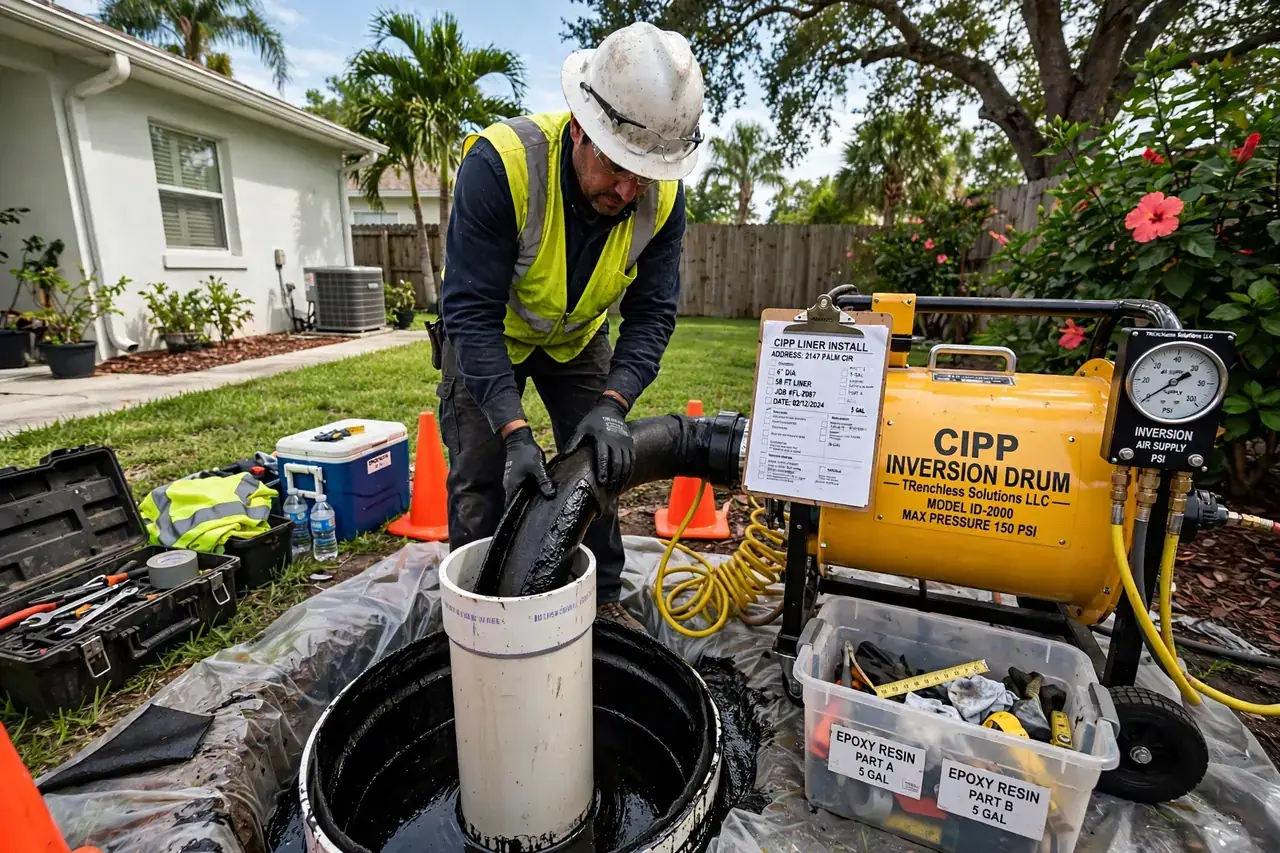
A jointless liner inside the old pipe closes every entry the roots used, which is what ends the cycle.
Read the guide
A root mass that finally seals the line shut is a same-day problem. Flow first, sealing plan second.
Read the guideThe symptom roots eventually produce: several drains failing together as the mass mats closed.
Read the guideThe leak at a root-entered joint often shows above ground as a wet, over-green patch on the line path.
Read the guideOne call starts with the camera, not the cutter. Reach us at (239) 448-0271 weekdays between 8am and 6pm, describe the repeat pattern and the trees over your line, and we will log the intrusions on video. Based at 1274 13th St N in Naples, serving Collier and Lee counties.